
Sourcey vs Redocly
Give the API reference a proper home.
Sourcey brings your OpenAPI reference and guides into one designed site. Redocly offers both open-source tools and a broader documentation platform. Start with the part you want to change.
Give people a docs link you’re proud to send.
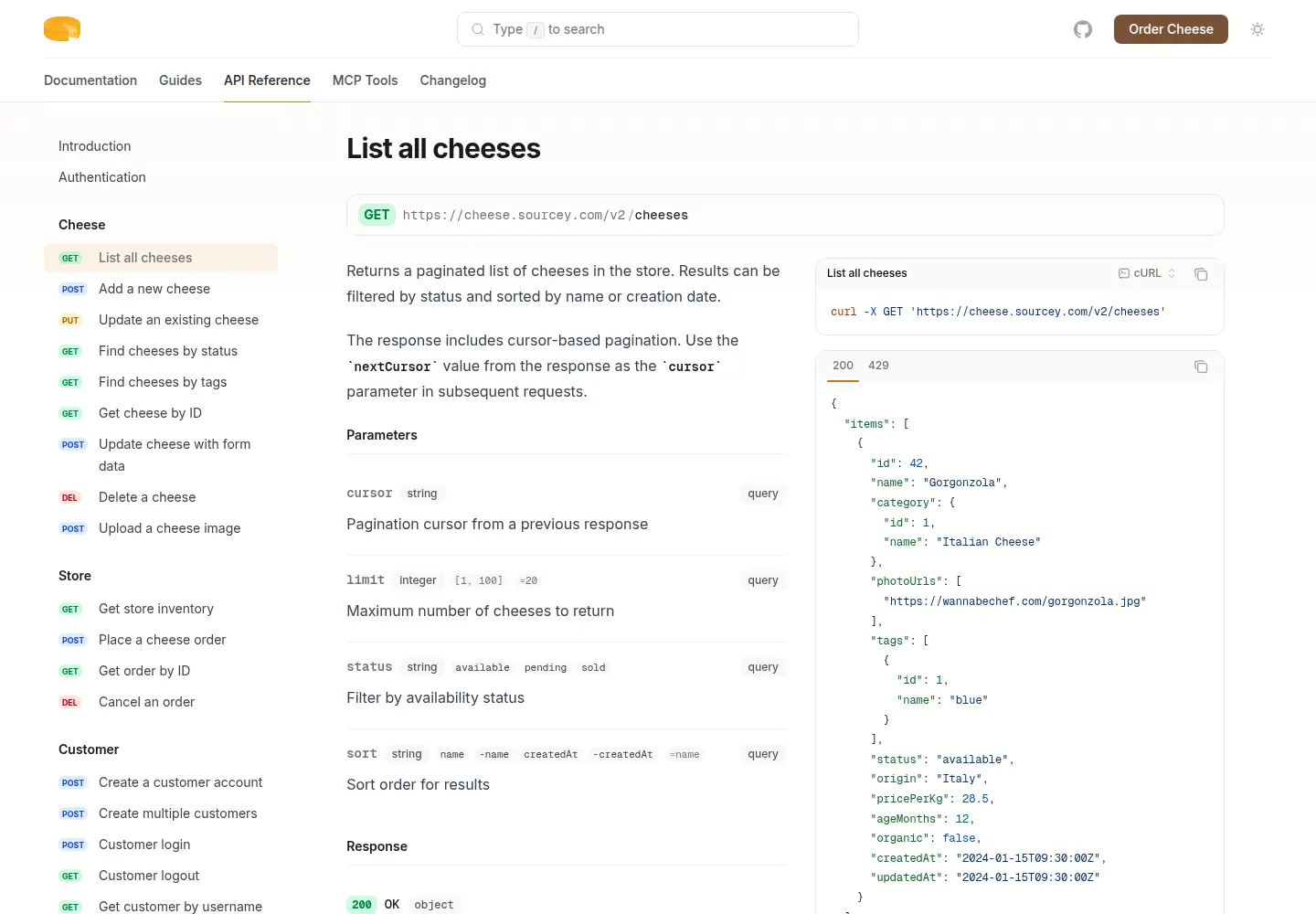
Cheesestore puts an OpenAPI reference beside guides and an MCP manifest in one Sourcey build. The cheese service is fictional; this is the actual generated site.
Which Redocly product are you comparing?
Redoc is a reference renderer. Redocly CLI handles OpenAPI tooling. The hosted products add publishing and portal features. Sourcey can replace the presentation without replacing your spec checks.
| Feature | Redocly | sourcey |
|---|---|---|
| OpenAPI reference | Redoc / Redocly platform | Built-in adapter |
| Self-hosted reference | Redoc CLI HTML build | Static site build |
| Guides with the reference | Platform or site integration | Markdown in the same build |
| OpenAPI linting and rules | Redocly CLI | Keep your spec tooling |
| Portal and team services | Redocly platform | Your existing tools |
| Doxygen, Go, Rust inputs | Separate generation workflow | Built-in adapters |
| Presentation | Redoc or platform themes | Sourcey themes and CSS |
| Software cost | Open-source tools; paid platform | Free; AGPL-3.0 |
Keep the tools that are doing useful work.
- 01
Redoc already has a self-hosted path
Redocly CLI’s build-docs command produces an HTML file you can host yourself. Moving to Sourcey is not necessary just to escape hosted rendering. The reason to consider it is the whole site: the reference, guides, navigation, search, and visual treatment you want to maintain together.
- 02
Do not throw out the linter
If Redocly CLI enforces your API rules, keep it in CI. Linting, bundling, and rendering are separate jobs. Sourcey reads the OpenAPI document you supply; it does not replace your organisation’s naming rules or prove that the running API matches the spec.
- 03
Judge the reference inside a real site
An operation page is rarely the whole explanation. Authentication, pagination, retries, and a first working integration need guides. Sourcey gives those pages the same typography and navigation as the generated reference. Cheesestore shows the result with a small spec you can inspect, rather than a screenshot filled with content your own build cannot reproduce.
- 04
A platform migration has more moving parts
Redocly’s hosted products include capabilities beyond the open-source renderer. Inventory the editing, review, access, and portal features your team uses before choosing what to replace. Sourcey suits a team that wants to run the docs build; a team buying an operated publishing platform has a different requirement.
Change the renderer in a separate build.
Keep the existing spec and validation as the baseline. Compare what each renderer produces from the same input.
- 01
Identify the current dependencies
Separate Redoc renderer settings, Redocly CLI rules, and hosted platform settings. Keep a copy of the current docs and a list of links people use to reach operations and schemas.
- 02
Try the parts of the spec that need attention
Choose examples using external references, security requirements, composed schemas, and vendor extensions. Confirm that the Sourcey output presents the information your readers need. A successful parse is only the first check.
- 03
Add the surrounding guides
This config puts two Markdown guides beside the OpenAPI reference. If the existing guides use platform-specific components or Markdoc tags, convert a representative page before estimating the rest.
import { defineConfig, markdown, openapi } from "sourcey"; export default defineConfig({ name: "My API", navigation: { tabs: [ { tab: "Guides", slug: "", source: markdown({ groups: [{ group: "Start here", pages: ["introduction", "quickstart"] }], }), }, { tab: "API", slug: "api", source: openapi("./openapi.yaml") }, ], }, }); - 04
Review links and publish a preview
Compare schema links, operation anchors, examples, and search results. Test a direct visit to an old URL. Keep the linter and release-version checks in the build after the presentation changes.
Common questions.
Is Redocly always a paid documentation platform?
No. Redoc and Redocly CLI provide open-source tooling, including a self-hosted HTML reference build. Compare Sourcey with the specific renderer or platform feature you use, rather than treating every Redocly product as a subscription.
Can I use Redocly CLI with Sourcey?
Yes. Keep linting and bundling in your existing pipeline, then point Sourcey at the OpenAPI input you want to publish. Keep that input tied to the API release so the site does not silently document a newer or older contract.
Will all Redoc vendor extensions look the same?
Do not assume so. Extensions can affect grouping, examples, and presentation differently in each renderer. Build a small sample using your important extensions and compare the result before moving the whole reference.